
Introduction
Smart AI solutions are changing the way people live, work, and make decisions every single day. From mobile apps to business software, these intelligent systems are designed to make tasks faster, easier, and more accurate. Today, many beginners feel curious but also confused about how smart AI solutions actually work and why they matter so much. This guide is written to clear that confusion in simple and practical language.
In the modern digital world, data is growing very fast. Humans alone cannot manage or analyze such large amounts of information efficiently. That is where smart AI solutions play a powerful role. They help automate routine tasks, provide useful insights, and support better decision-making across many industries. Even small businesses and students now benefit from tools that were once available only to large companies.
Another reason smart AI solutions are gaining attention is their ability to learn and improve over time. Unlike traditional software, these systems adapt based on experience. As a result, they become more accurate and useful with continued use. This learning ability makes them valuable for both short-term and long-term goals.
This article will explain smart AI solutions step by step, without technical confusion. You will learn what they are, why they are important, how to use them correctly, and what mistakes to avoid. Whether you are a beginner or an intermediate learner, this guide will help you understand smart AI solutions clearly and confidently.
What is Smart AI Solutions?
Smart AI solutions refer to intelligent systems that use artificial intelligence to solve real-world problems in an efficient and adaptive way. These solutions combine data, algorithms, and learning models to perform tasks that normally require human intelligence. Examples include voice assistants, recommendation systems, automated customer support, and predictive analytics tools.
Unlike simple automation, smart AI solutions do not just follow fixed rules. Instead, they analyze patterns, learn from past data, and improve results over time. This ability allows them to handle complex tasks such as recognizing images, understanding language, or predicting outcomes.
Smart AI solutions can be software-based, hardware-based, or a combination of both. For example, a smart chatbot is software-driven, while a smart robot uses both physical components and intelligent programming. In all cases, the goal is to make processes smarter, faster, and more reliable.
These solutions are now used in education, healthcare, finance, marketing, manufacturing, and even daily household activities. As technology continues to advance, smart AI solutions are becoming more affordable and accessible to everyone.
Why is Smart AI Solutions Important?
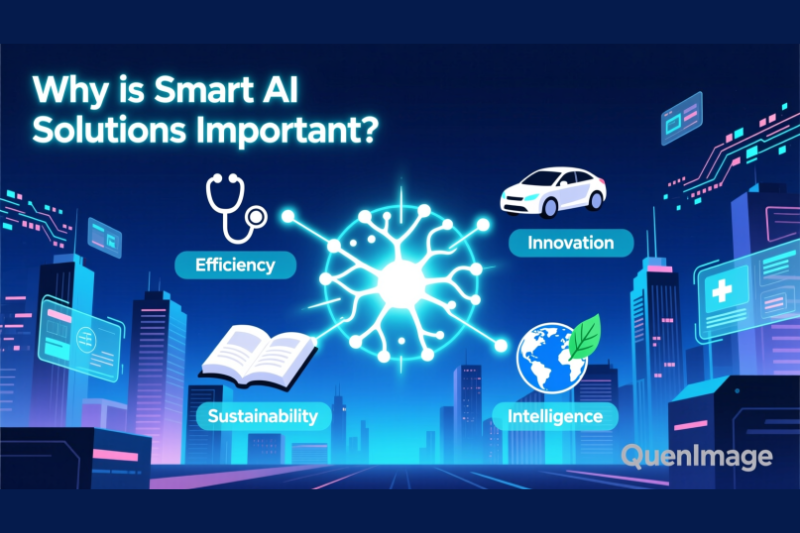
Smart AI solutions are important because they help people and organizations manage complexity with ease. In a fast-paced world, efficiency and accuracy are critical. AI-powered systems reduce human effort while improving overall performance.
One major reason for their importance is time savings. Tasks that once took hours can now be completed in minutes. This allows professionals to focus on creative and strategic work instead of repetitive activities. For students and beginners, smart AI solutions provide learning support and personalized guidance.
Another key factor is better decision-making. Smart AI solutions analyze large datasets and identify patterns that humans might miss. This leads to more informed and reliable decisions, especially in areas like business planning and healthcare diagnosis.
Cost reduction is also a strong benefit. By automating tasks and reducing errors, organizations can save resources. Even small businesses can compete more effectively using smart AI solutions.
Finally, these solutions support innovation. They open new possibilities for products, services, and experiences. As a result, smart AI solutions are not just tools, but drivers of future growth and development.
Detailed Step-by-Step Guide
Step 1: Identify the Problem
Before using smart AI solutions, clearly define the problem you want to solve. It could be saving time, reducing errors, or improving customer experience. A clear goal helps choose the right solution.
Step 2: Collect Relevant Data
Data is the foundation of smart AI solutions. Gather accurate and relevant information related to your problem. Clean and organized data improves system performance.
Step 3: Choose the Right AI Model
Different problems require different AI models. Some focus on prediction, while others specialize in language or image processing. Select a model that matches your needs.
Step 4: Train the System
Training involves feeding data into the AI model so it can learn patterns. This step may take time but is essential for accuracy. Better training leads to smarter outcomes.
Step 5: Test and Evaluate
After training, test the smart AI solutions with real scenarios. Check accuracy, speed, and reliability. Make adjustments if needed.
Step 6: Deploy and Monitor
Once satisfied, deploy the system in a real environment. Continuous monitoring ensures it stays effective and adapts to new data.
Step 7: Improve Over Time
Smart AI solutions work best when updated regularly. Add new data and refine settings to maintain performance and relevance.
Benefits of Smart AI Solutions
- Improve efficiency and productivity
- Reduce human error
- Save time and operational costs
- Support better decision-making
- Provide personalized user experiences
- Adapt and learn over time
- Increase competitiveness
Disadvantages / Risks
- High initial setup cost
- Dependence on data quality
- Privacy and security concerns
- Lack of human judgment in some cases
- Risk of bias in training data
- Need for technical maintenance
Common Mistakes to Avoid
Many beginners make the mistake of using smart AI solutions without a clear goal. This leads to poor results and frustration. Always define your purpose first.
Another common error is ignoring data quality. Poor data produces poor outcomes. Ensure your data is accurate and relevant.
Over-automation is also a risk. Not every task needs AI. Use smart AI solutions where they truly add value.
Finally, failing to monitor performance can cause problems. Regular evaluation is necessary to keep systems effective and reliable.
FAQs
What are smart AI solutions used for?
Smart AI solutions are used for automation, prediction, analysis, and personalized experiences across many industries.
Are smart AI solutions suitable for beginners?
Yes, many tools are designed with simple interfaces, making them easy for beginners to use and understand.
Do smart AI solutions replace humans?
No, they support humans by handling repetitive tasks and providing insights, not replacing human creativity.
How expensive are smart AI solutions?
Costs vary widely. Some are affordable or free, while advanced systems require higher investment.
Can small businesses use smart AI solutions?
Yes, many solutions are designed specifically for small and medium-sized businesses.
Are smart AI solutions safe to use?
They are generally safe when proper security and ethical practices are followed.
Expert Tips & Bonus Points
Start small and scale gradually when using smart AI solutions. This reduces risk and builds confidence.
Always focus on user experience. A solution is only smart if it is useful and easy to use.
Regularly update your system with new data to keep it accurate.
Educate your team or yourself about basic AI concepts to make better decisions.
Balance automation with human oversight for best results.
Conclusion
Smart AI solutions have become an essential part of modern life and business. They help simplify complex tasks, improve efficiency, and support better decision-making. For beginners and intermediate users, understanding these solutions is no longer optional. It is a valuable skill for the future.
Throughout this guide, we explored what smart AI solutions are, why they matter, and how to use them step by step. We also discussed their benefits, risks, and common mistakes to avoid. With the right approach, these intelligent systems can deliver powerful results without unnecessary complexity.